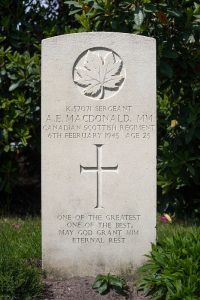
Sgt Albert Ernest MacDonald 12-H-15
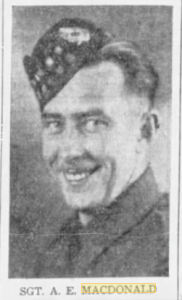
Albert was born on September 30 1919 in Penticton British Columbia, the son of Albert Earnest and Margaret K. E. MacDonald. He was the husband of Gladys Mary MacDonald, of Victoria British Columbia. Their children were Jacqueline (5) and Ronald (3) MacDonald and his brothers were Harold and Frank MacDonald. The other brother Wilfred Andrew MacDonald was already deceased in 1932.
Albert (Jeff) was a grocery clerk prior enlistment and member of the Church of England.
He enlisted on September 9 1939 in Victoria and he went on September 2 1941 overseas to the UK and he went thereafter on June 6 1944 during the D-Day landing to Normandy. And after that he went back to England (date and reason unknown) and he disembarked on September 3 1944 France again.
He was captured in January 1945 by the Germans during a patrol and he was seriously wounded at the Waal River (Holland).
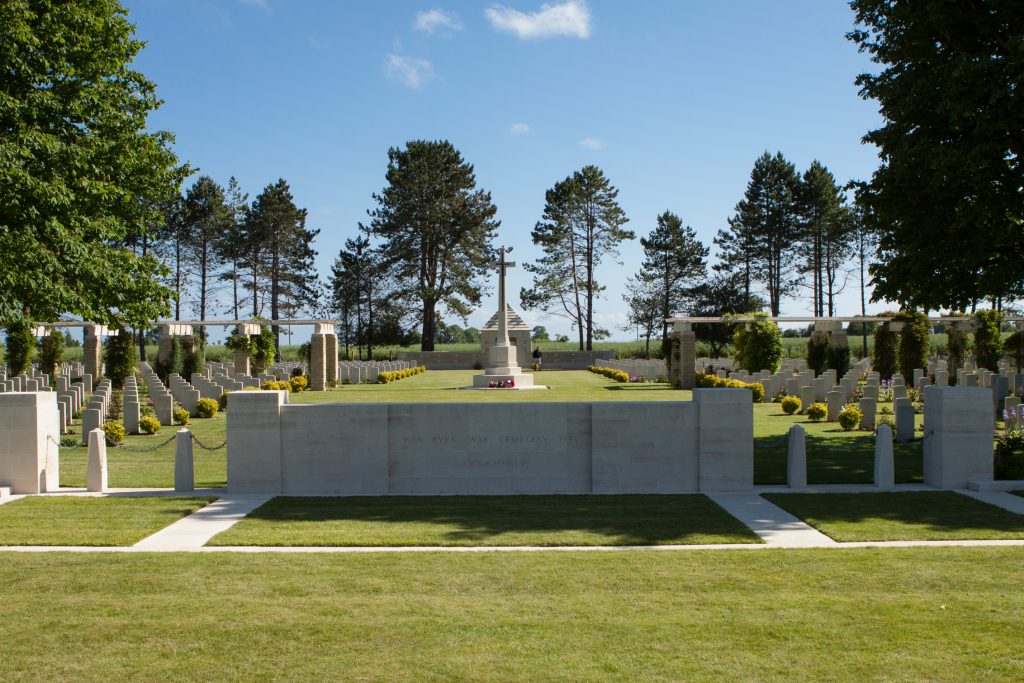
Albert died of these wounds whilst prisoner of war on Tuesday February 6 1945 at the age of 25 at Haldern West-Germany and he was temporarily buried there before being reburied on August 12 1946 in Holten.
On his headstone: One of the greatest One of the best May God grant him Eternal rest
His medals were: 1939-45 Star; France Germany Star; War Medal; Defence Medal; CVSM & Clasp and he was awarded on October 15 1944 the Military Medal due to very bravery conduct near The Leopold Canal Belgium and Eede Holland.
He served with the 1st Bn The Canadian Scottish Regiment and also before with The North Nova Scotia Highlanders.
>>
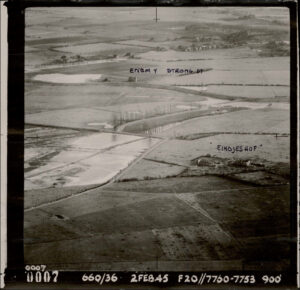
De Eindjeshof, February 1945, on an Allied aerial photograph. Photo: Library and Archives Canada.
It was cold and cloudy when Sgt Albert Ernest MacDonald went on patrol on the evening of January 26, 1945. He was in charge of a small group of ten men in total.
MacDonald and his men (Canadian Scottish Regiment) had to carry out an operation in the Erlecomsepolder, east of Nijmegen. The ten men had to make their way to the Eindjeshof farm under cover of the cloudy night, entrench themselves there for at least 24 hours, and, if possible, return with a number of prisoners of war. Along the way, they laid a telephone line to an abandoned ‘dugout’.
On Friday evening, January 26, at 7 o’clock, MacDonald’s group departed. The operation was given the code name ‘Alfred’. The group of ten first set up a telephone line from an abandoned ‘dugout’. Afterward, MacDonald, together with soldiers Ernest David Harrison, Dunn, and Forsyth, proceeded along the Erlecomsedijk through enemy territory. At five minutes to one in the morning, ‘Alfred’ reported to the dike near the Eindjeshof (now Erlecomseweg 80 in Erlecom). MacDonald told Dunn and Forsyth to lie low at that spot. He himself would head towards the estate with Harrison. Dunn and Forsyth would keep an eye on MacDonald and Harrison.
On the way to the Eindjeshof itself, which was located about a hundred meters from the road, MacDonald and Harrison came under fire. Dunn and Forsyth saw no opportunity to rescue their two mates. Dunn stated upon returning to headquarters: “Soldier Forsyth asked Sergeant MacDonald if we should come after them, but he said no, and that he would be back in an hour. He also said that if anything happened, we had to return to our headquarters with information as quickly as possible. Where we were, we had no cover from enemy fire except in a roadside ditch, but when the enemy fire started, we came into a crossfire from two houses, which trapped us. Because both sides of the road were under fire, we crawled to a safe spot as quickly as possible.
When we reached cover, we waited a moment to see if Private Harrison or Sergeant MacDonald were coming. Since we saw no sign of them, we went to our headquarters and reported what had happened.”
MacDonald: “I will stay away for an hour”
Soldier Forsyth recounted: “I asked Sergeant MacDonald if he wanted Private Dunn and me to follow him.
He said: ‘No, I will be away for an hour, and if we all go, we would expose ourselves too much if there are enemies in the houses.’ So I stayed where I was. He said that if we were fired upon, we had to seek cover in a ‘dugout’ or flee as fast as possible and inform our headquarters.
From the position we were in, we received cover from fire from one of the houses. When they opened fire from the other house, we had no more cover. We were right in the enemy’s line of fire and pinned down, but we managed to crawl away and seek cover. There we looked to see if we could spot Sergeant MacDonald or Private Harrison, or the enemy, but we saw nothing. We waited a few minutes, keeping our eyes peeled; nothing happened.”
Last seen at 3:30
MacDonald and Harrison were last seen on Sunday morning, January 28, at 3:30. They were reported missing.
What had happened to MacDonald remained unclear for a long time. His wife, Gladys, received a letter sent on March 16, 1945, by Lt. R.T.E. Hicks-Lyne, who wrote: “It is possible that your husband is a prisoner of war; however, this cannot be considered official.
We regret that there is nothing more concrete to report regarding your husband’s whereabouts, but you can be assured that you will be notified immediately as soon as we receive official news about this.”
Five days later, Gladys received the sad news by telegram that her husband had been taken prisoner of war and had died in captivity on February 6, 1945, at 11:30 p.m.
Cause of death: meningitis
It turned out that MacDonald had sustained a spinal injury and, according to the Chief Physician’s report, had contracted meningitis. MacDonald died in the Kriegslazarett at the Haus Aspel monastery near Rees. He was buried by the Germans in Haldern.
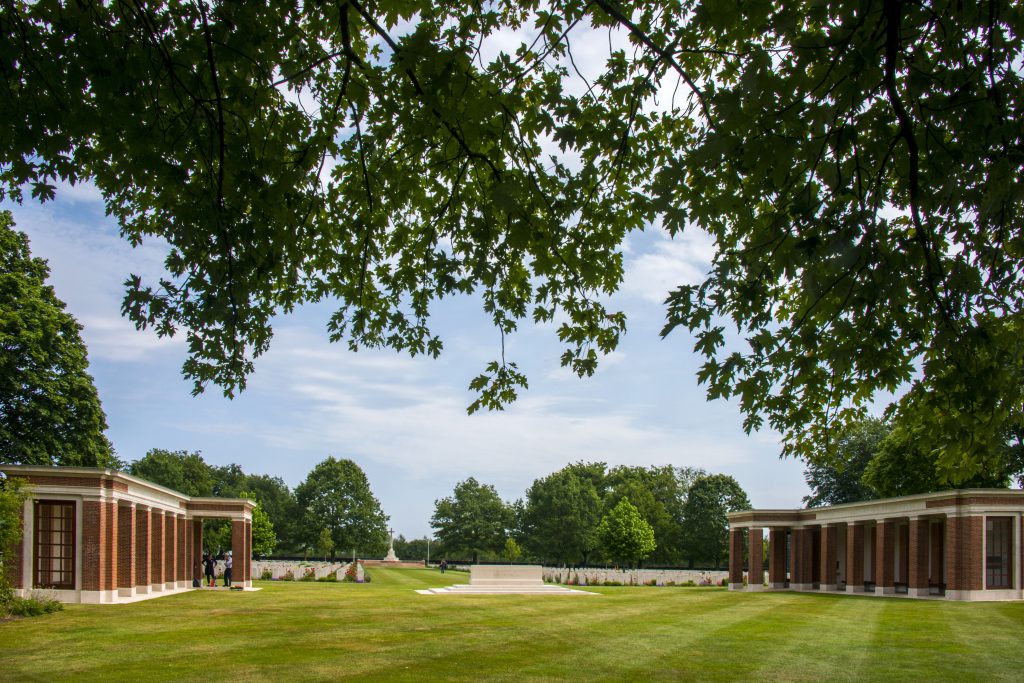
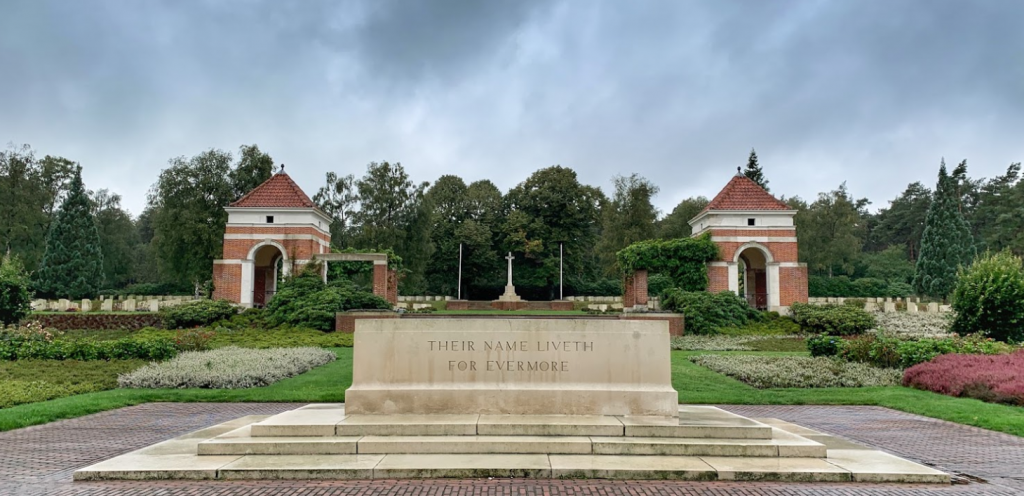
It took some time before the Canadian army knew where he was buried. In 1948, MacDonald was reburied at the Canadian cemetery in Holten. He lies in plot 12, row H, grave 15.
Gladys MacDonald remained behind in Canada with two children: their three-year-old son Ronald Jeffrey and four-year-old daughter Jacqueline Margaret.
Ernest David Harrison was fatally wounded during the action. His remains were never recovered. In 1947, a German minister had indicated the location where Harrison was supposedly buried in a letter to the family, but an investigation at that site in 2012 yielded no results. A monument was erected in 2014. Harrison is listed as ‘missing’ on panel 11 at the Canadian cemetery in Groesbeek.
©2026 Jan Braakman (click here fore the site)
<<